
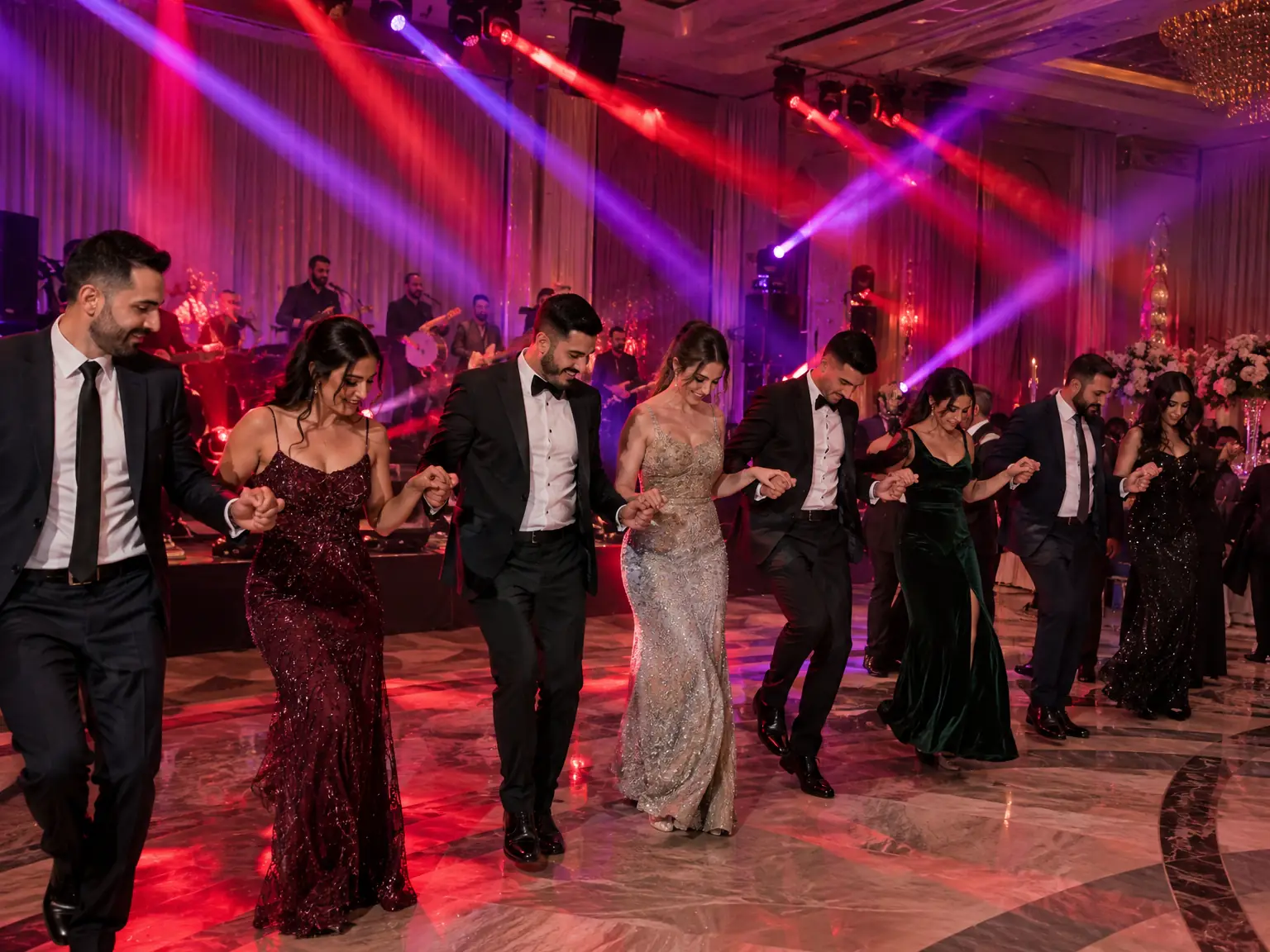
The hardest part of an Arabic wedding is not knowing the music. It is knowing when to switch. Families often have strong, opposite expectations about the night, and a DJ who alternates randomly will empty the floor twice an hour.
Treat the night as blocks, not a blend
Blending everything into a continuous mix sounds sophisticated and usually fails. Arabic weddings work better with clear blocks: an Arabic opening, a Western middle, an Arabic revival, and a late-night finish. Each block is long enough to build momentum.
Announcing nothing is the key. The transition itself does the work, as long as the tracks share tempo or energy at the seam.
The zaffa and the entrance set the tone
If you have a zaffa, a drummer or a troupe, that entrance is the emotional peak of the early night. The DJ’s job is to support it, keep volume controlled for the venue, and land a transition that carries the energy into the first dance.
Coordinate the order in advance: who enters, in what sequence, and which track marks the change. Improvising this on the night is where things go sideways.
Dabke needs time and volume
A single dabke track between Western songs is a tease. Guests need several songs to form a line and stay in it. Give the dabke block fifteen to twenty minutes, and make sure the sound system can carry the low end without distorting.
If your venue has a sound limit, plan the block earlier when the room is fuller and the energy is already high.
Crossover tracks are your bridge
Certain tracks work for both sides of the room: Arabic pop with Western production, Latin-Arabic fusions, and familiar global hits with a danceable rhythm. Use these at the seams of each block rather than in the middle.
The goal is that no guest experiences a hard stop. A crossover track gives everyone a reason to stay standing while the language of the music changes.
Ask about family expectations first
Before I build a set list, I ask three questions: which traditions must happen, which songs belong to which family, and what time the older guests will leave. The answers shape the order of the night more than any playlist.
That conversation is also where sensitivities surface, from alcohol to song choices to how the couple should be introduced. Better to hear it a month early than on the microphone.
Key takeaways
- Sequence Arabic and Western music in deliberate blocks with crossover seams.
- Give dabke a real block of fifteen to twenty minutes.
- Choreograph zaffa and entrances in advance with the DJ.
- Ask families about must-happen traditions and sensitivities before the event.