
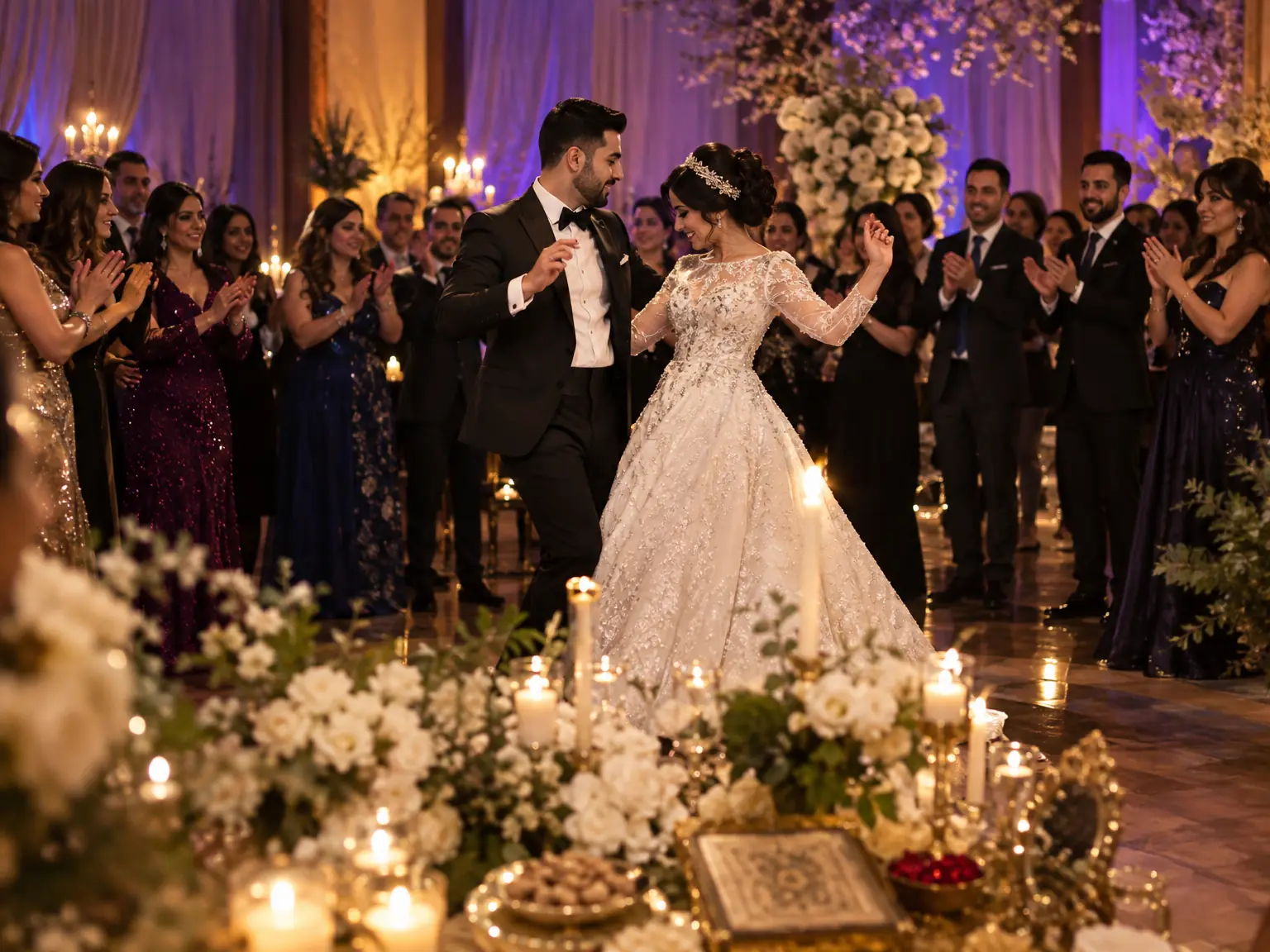
Persian weddings have a musical arc shaped by the ceremony, family traditions and the guest list. There is a ceremony tone, a dinner tone, a family-dance tone, and a late-night tone, and they are not interchangeable. Thoughtful sequencing gives each generation a familiar moment and helps build a lively dance floor.
The ceremony is not the party yet
During the Sofreh Aghd, the music serves the ritual. Soft instrumental Persian music, low volume, and clear cues for the entrance and the vows. Anything with a heavy beat pulls attention away from the moment and makes the room feel impatient.
The moment the ceremony ends, the tone should flip. That transition, handled in a single cue, is one of the most satisfying moments of a Persian wedding. Guests need to hear that the formal part is over.
Build the family dance block deliberately
Persian receptions usually include a period where the older generation owns the floor. Classic tracks, 6/8 rhythms and songs the aunties know every word to. This is not the time to test new releases. It is the time to make the elders feel honored, and it buys enormous goodwill for the rest of the night.
Once that block lands, younger guests are already standing. That is the moment to move into modern Persian pop, then into a crossover set.
Modern Persian pop is not a replacement
Younger guests want the new sound, and they should get it. But playing only modern Persian music in the first hour empties the floor for the parents, and playing only classics loses the cousins. Alternating every few tracks keeps both groups in the room.
The best sequence I use most often is: classics, modern Persian, one crossover Western track, then back. By the third cycle the floor is mixed and stays mixed.
Where Western music fits
Top 40, hip-hop and house work best late, after the Persian blocks have established the night. Crossover moments, a Latin track after a Persian set, or an EDM drop everyone recognizes, give the room a shared release.
The mistake is treating Western music as the default and Persian music as the special request. At a Persian wedding, the opposite is true, and the night feels more generous when the majority of guests hear their music first.
Plan the knife dance and the peak
The knife dance is a choreographed build. It needs the right track, a clear cue and a DJ who is watching the dancers rather than the laptop. Plan it for when the floor is already full, not as an opener.
After it, do not drop the energy. The ten minutes following the knife dance are the easiest ten minutes of the night to lose.
Key takeaways
- Keep ceremony music soft, instrumental and cue-driven.
- Give the older generation a real classics block early.
- Alternate classics and modern Persian pop instead of choosing a side.
- Place the knife dance at an energy peak and hold the floor afterward.